Press ESC to close

NOx emissions consist of three categories: thermal NOx, prompt NOx, and fuel NOx.
Thermal NOx is primarily formed when nitrogen in the air is oxidized to NOx at high combustion temperatures (above 1,500°C). Its formation is governed by three key factors: combustion temperature, oxygen concentration, and residence time at high temperature.
Prompt NOx is generated during the combustion of fuel-rich mixtures of hydrocarbon fuels. It is typically only a major consideration during low-temperature combustion of nitrogen-free hydrocarbon fuels.
Fuel NOx originates from the oxidation of nitrogen compounds present in the fuel during combustion. Its formation is highly dependent on the combustion atmosphere and initiates at approximately 700°C. For gas-fired boilers, fuel NOx is significantly less prevalent than thermal NOx.
As thermal NOx formation is dictated by temperature, oxygen, and residence time:
NOx formation is negligible below 1,500°C but increases exponentially above this threshold.
Higher oxygen concentrations elevate peak flame temperatures, leading to greater NOx generation.
Longer residence time in the high-temperature zone increases total NOx emissions.
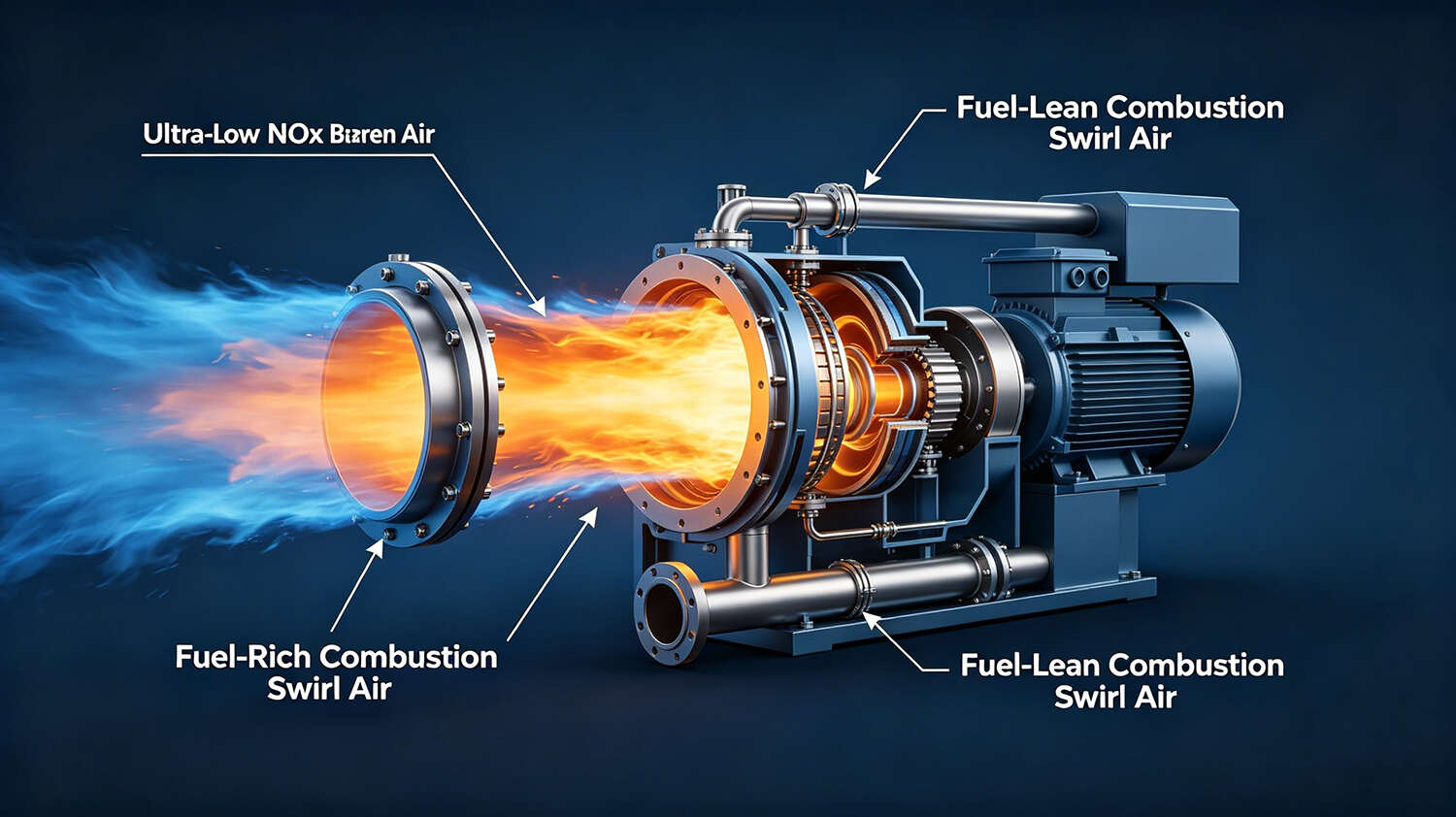
Low NOx Combustion Technology: Staged & Rich-Lean Combustion
This project utilizes staged air combustion and rich-lean (off-stoichiometric) combustion technologies. Combustion air enters the low NOx burner through the primary air inlet and is distributed via dedicated air passages at the burner nozzle. Specifically designed for low-calorific-value blue-coke tail gas, the burner features three combustion zones:
1. Primary (Center) Combustion Air (1st stage)
2.Rich-Fuel Swirl Air (2nd stage)
3.Lean-Fuel Swirl Air (3rd stage)
These air streams mix with corresponding rich and lean fuel streams, enabling controlled rich-lean and staged combustion. This mechanism homogenizes the furnace temperature field and effectively suppresses thermal NOx formation.
System & Layout Description
Based on the fuel type and system power rating, each boiler is equipped with four burners, arranged in two layers on the front wall (two burners per layer).
The low NOx burner operates on the principles of axial aerodynamics and fuel staging. It employs a synergistic effect of swirl flow and bluff-body recirculation to ensure uniform distribution of fuel and air, achieving super-mixing. This results in a homogeneous flame temperature profile, which is critical for minimizing thermal NOx generation.
Beyond the burner body and nozzle, the complete combustion system comprises three main subsystems:
1. Gas Pipeline System: Includes main and branch gas lines, equipped with manual shut-off valves and pressure gauges.
2. Combustion Air System: Customized for site conditions, with a damper actuator installed in the main air duct for automatic airflow regulation in response to load changes.
3. Control System: Manages and optimizes the entire combustion process.
