Press ESC to close

Lightning is characterized by extremely short discharge duration, massive discharge current, and ultra-high discharge voltage, resulting in severe destructive power. Its damaging effects manifest in three primary forms:
1. Mechanical Damage
Caused by two distinct forces:
• The enormous electrodynamic force generated as lightning current passes through an object.
• The intense internal pressure from rapid vaporization and expansion of moisture and gases within the object, due to the extreme heat generated by lightning.
2. Thermal Damage
The tremendous heat released by lightning can ignite combustible materials and melt metallic components.
3. Insulation Breakdown Damage
The exceptionally high voltage can puncture insulating and anti-corrosion materials in metallic gas pipelines and electrical systems. This leads to failure of anti-corrosion layers and phase-to-phase short circuits, further escalating and extending the scope of destruction.
All three types of damage pose significant risks to gas transmission and distribution systems. Due to the nature of gas transportation, gas facilities and pipeline networks are widely distributed across urban and suburban areas. These include:
• Pressure-regulating stations and pipelines in rural outskirts.
• Overhead gas pipelines and risers on high-rise and multi-story buildings.
• District regulator stations along municipal roads.
• Building regulator boxes in residential communities.
• SCADA systems for monitoring and controlling gas equipment and networks.
Owing to process requirements or location constraints, many of these facilities lie outside the protection coverage of building lightning protection systems, necessitating independent lightning protection measures.
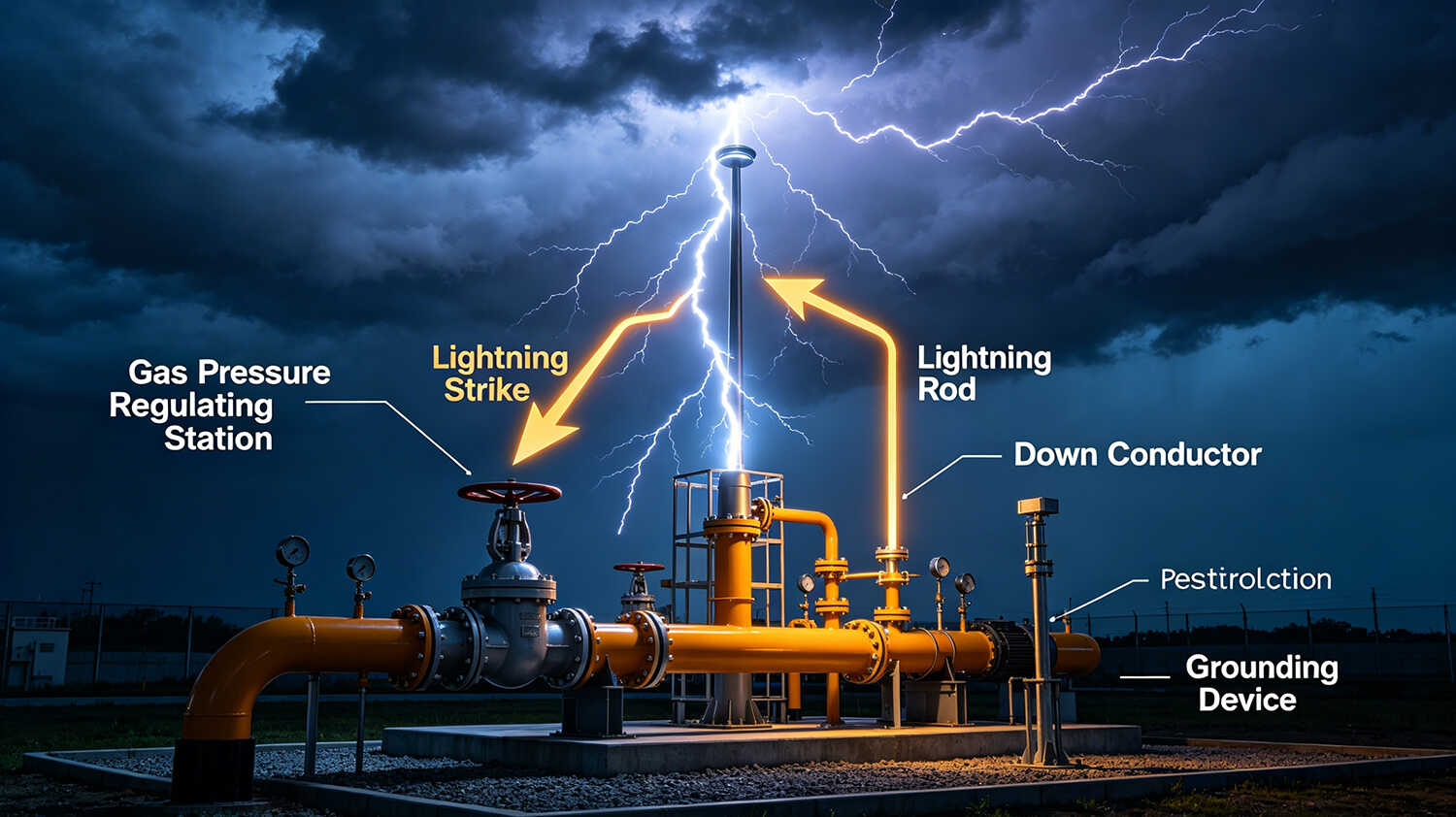
Direct lightning protection primarily employs an air-termination system, consisting of three core components:
• Air-termination devices: Available as lightning rods, lightning strips, or lightning meshes.
• Down-conductors: Can be installed exposed or concealed.
• Grounding systems: May utilize natural grounding electrodes, foundation grounding electrodes, or artificial grounding electrodes based on site conditions.
The air-termination device intercepts lightning current, which is safely conducted to the ground via down-conductors and grounding electrodes, thereby protecting buildings and equipment within the protected zone from direct strikes.
However, a lightning protection system is only effective with proper design, correct installation, and regular maintenance. Adequate grounding is critical for safeguarding against induced lightning and lightning surge intrusion. Without it, the system not only fails to protect but can actually attract lightning strikes.
